

Table of contents
- What people really mean by ‘lanyard types’
- How your branding behaves and the decisions that matter
- Branding-led summary
- The material facts of comfort versus longevity
- Types of lanyard and attachments for safety and usability
- Choosing lanyard types by real-world use case
- Lanyard attachments and the problems that actually occur
- Artwork, proofs and lead times for smart procurement
- Commonly asked questions
Choosing the right types of lanyard isn’t a cosmetic decision. The type you choose affects how your branding looks in the real world, how comfortable it is to wear all day, whether it meets workplace safety expectations, and how reliably it works with wallets, ID cards, passes, access systems and other attachments.
This guide explains the real choices that matter, in plain terms, based on how lanyards are actually used across UK workplaces, events, schools and healthcare settings.
Start here if you’re short on time
If your branding is complex or colour-critical, dye sublimation lanyards are the right starting point. If your branding is bold and simple, screen print or woven options will often be more efficient and just as effective. Most problems arise when the print method doesn’t match the artwork—not when the colour or width is wrong.
Quick clarification: This guide covers promotional and ID lanyards (badges, passes, access cards). If you’re looking for working-at-height safety lanyards used with harnesses, those are PPE products governed by different standards and selection rules.


What people really mean by ‘lanyard types’
Most people assume there’s a single answer to the type or size of lanyard they need. In reality, you’re choosing across several overlapping decisions:
- How the branding is applied.
- What the lanyard is made from and how it feels.
- How it behaves in daily use (safety, comfort, reliability).
- What it’s being used for, and by whom.
The mistake is tackling these in the wrong order. The fastest way to narrow things down is to start with how your branding needs to behave, because that immediately narrows your focus.
How your branding behaves and the decisions that matter
Before looking at materials, widths or attachments, it’s worth being blunt about this: branding behaviour dictates everything else. Choosing the wrong print method and trying to fix it later with tweaks is the fastest way to end up disappointed.
If your logo includes gradients, tonal shifts, fine detail or a repeating pattern, the print method isn’t a preference; it’s a technical requirement. Equally, if your branding is deliberately bold and minimal, some premium options are unnecessary.
Fast rule-of-thumb
- Complex branding (gradients / patterns / multi-colour) start with dye sublimation.
- Simple branding (bold logo and text) start with screen print.
- Simple branding and you want a textured, durable finish—consider woven.
Common mistake: Choosing screen print because it’s familiar, then trying to squeeze in gradients, shadows, or tiny type. That’s how you end up with a lanyard that technically matches the logo… but looks terrible.
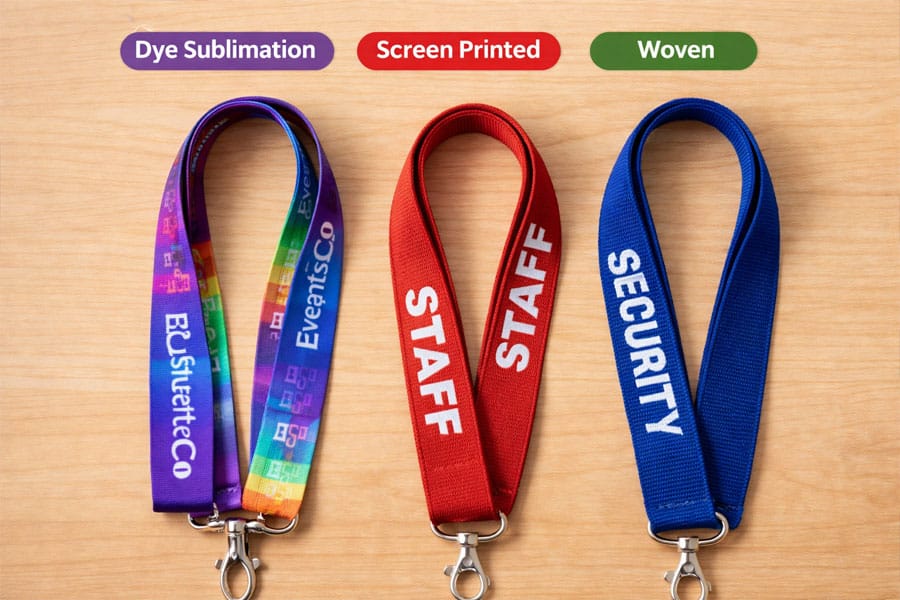
Common lanyard types include dye sublimation, screen printed and woven, with dye sublimation printing being the most popular.
Dye sublimation lanyards
Dye sublimation is the most flexible of all the lanyard types and a visually accurate way to print your design. The design is infused into the material, allowing full colour, edge-to-edge coverage.
This is the correct choice when branding accuracy matters. If your organisation has invested in a considered visual identity with gradients, colour transitions, background patterns, photography, dye sublimation will reproduce it consistently across the full length of the strap.
Where it shines (practical examples):
- Sponsored event lanyards where colour and impact matter.
- Brand-led organisations with strict visual guidelines.
- Patterns that must look intentional, not stamped on.
Where to be careful:
- Very small text on busy backgrounds (legibility is a design problem, not a print problem).
Screen printed lanyards
Screen printing works best when the branding is simple and intentional. Bold logos, high-contrast text and limited colour palettes tend to look exceptionally crisp using this method.
It’s popular for branded staff lanyards, visitor passes and education settings because it delivers clarity at scale and keeps costs predictable for larger orders.
Best-fit signals:
- You want text to read clearly at a glance.
- Your logo is flat colour (no gradients).
- You reorder regularly and want repeatable results.
Limitations:
- Gradients, shading and photographic detail don’t belong here.
- The more colours you add, the more you add complexity and cost.
Woven lanyards
Woven lanyards sit in a different category. The design is stitched into the material rather than printed on the surface, giving a textured, durable finish that feels more permanent.
They’re often described as premium lanyard types, which is true, but only when the branding suits the medium. Simple logos, symbols and typography work well. Complex artwork usually doesn’t.
Choose woven when:
- The lanyard is part of a longer-term uniform and identity system.
- You want durability and a more restrained, professional look.
- Your design works in limited colours and clear shapes.
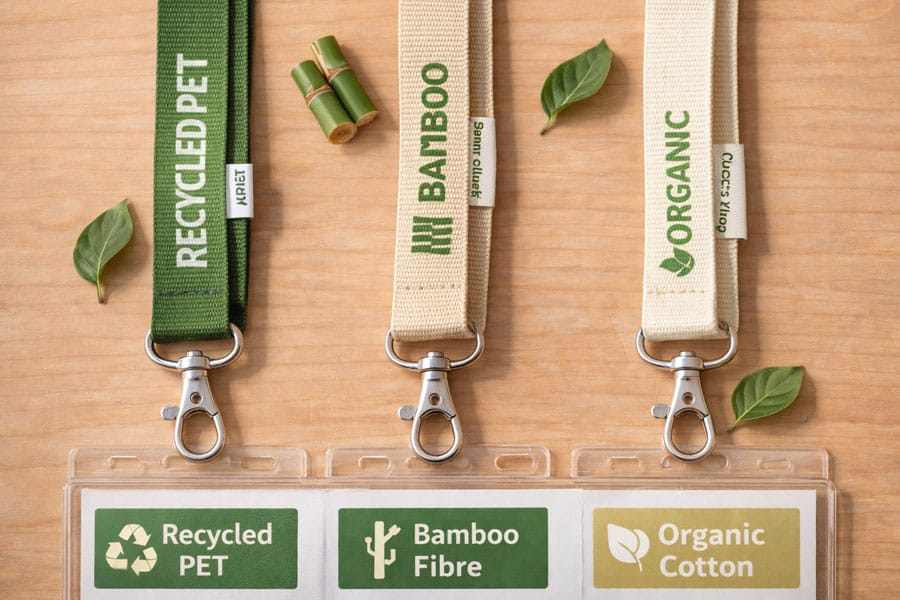
You can also go green with eco-friendly lanyard types such as recycled, bamboo and organic cotton.
Branding-led summary
If you’re pressure-testing a decision internally, this lanyard types table is usually enough to align stakeholders quickly.
| If your branding looks like this | The right direction | What you’re optimising for |
| Gradients, patterns, multiple colours | Dye sublimation | Accuracy and visual impact |
| Bold logo, simple text, high contrast | Screen print | Legibility and consistency |
| Minimal design, long-term daily wear | Woven | Durability and premium feel |
The material facts of comfort versus longevity
Once the print method is clear, material and construction become the next meaningful variables. These affect how the lanyard feels around the neck, how it wears over time, and how suitable it is for long shifts or high-movement environments.
- Flat polyester remains the most common option in the UK because it balances comfort, print quality and cost. Wider flat straps also distribute weight better, which is why they’re often preferred for all-day wear at events or in workplaces.
- Tubular constructions tend to feel softer and lighter, making them popular for promotions and large-scale giveaways. They’re comfortable, but visually more understated and less suited to complex branding.
- Woven constructions prioritise durability and texture. They hold their shape well and resist wear, which is why they’re frequently chosen for permanent staff lanyards rather than short-term use.
- Eco-focused materials such as recycled rPET or natural blends sit alongside these constructions rather than replacing them. An eco-lanyard can still be dye sublimated or screen printed; the difference lies in the source material, not the function.
Types of lanyard and attachments for safety and usability
Once branding is resolved, safety and usability are where procurement, HR and operations tend to weigh in. These features don’t usually change how the lanyard looks, but they make a big difference to whether it’s accepted, worn consistently, and compliant with internal policies.
A lanyard that looks good but behaves badly quickly becomes a problem. This is especially true in schools, healthcare and workplaces with safety policies.
- Breakaway safety features are now standard in many environments. They’re designed to separate under force, reducing the risk of snagging or injury. Placement and strength can vary, which is why it’s important to match the breakaway style to the environment rather than treating it as a checkbox.
- Quick release buckles solve a different problem. They allow the ID card or pouch to be detached without removing the lanyard itself and is useful where ID badges are scanned frequently or need to be shown repeatedly.
Width also matters more than most buyers expect. Narrow lanyards can feel lightweight, but wider straps are often more comfortable over long periods because they spread the load and reduce pressure points.

Your lanyard needs to be used in the real world such as conferences, workplaces, schools and healthcare.
Choosing lanyard types by real-world use case
Thinking in use cases for lanyard types helps avoid over-specifying. In practice, most organisations need lanyards to quietly do their job without drawing attention for the wrong reasons.
Conferences and exhibitions
Here, visibility wins. Lanyards need to carry branding clearly at distance, remain comfortable for a full day, and work seamlessly with badge holders and wallets handed out at speed. Dye sublimation is often the default choice, with wider straps and robust clips. Screen print works well when sponsor text or role identification needs to be immediately legible.
Workplaces and offices
Consistency and comfort matter more than impact. Staff wear these daily, so durability, safety breakaways and reliable hardware are key. Screen printed or woven lanyards are common here, depending on how complex the branding is and whether the organisation prefers a softer or more structured look.
Schools and education
Safety comes first. Breakaway features are typically essential, and clarity helps distinguish staff, students and visitors at a glance. Comfort also matters, particularly for younger wearers, which is why softer constructions are often favoured.
Healthcare environments
Healthcare settings balance safety, practicality and long shifts. Lanyards must be comfortable, compatible with access cards, and appropriate for infection control policies. Screen print remains popular for clarity, while dye sublimation is used where colour coding or detailed branding is required.
Warehouses, security and access
Here, reliability outweighs aesthetics. Strong clips, optional double-ended attachments and quick release features reduce failure points in active environments.
Lanyard attachments and the problems that actually occur
It’s common to focus heavily on the strap and treat the attachment as an afterthought. In reality, most functional complaints such as twisting passes, cracked holders, broken clips originate here.
In practice
If you already know what will hang from the lanyard (badge holder, PVC wallet, reel, keys), that should inform the attachment choice before finalising the lanyard build. In practice, attachment choice causes more issues than strap choice. Twisting, flipping badges, cracked holders and failed clips are all common complaints, and nearly all of them come down to mismatched hardware.
- Single clips suit most standard badge holders.
- Double clips help wider passes sit flat.
- Heavier items benefit from stronger clips or reels.
If you already know what will hang from the lanyard, that information should inform the build from the start.
Artwork, proofs and lead times for smart procurement
This is where marketing teams protect themselves from awkward follow-up conversations. A lanyard proof should never be approved on aesthetics alone. It should be checked for legibility at actual size, spacing consistency, and how the design repeats over length.
Artwork
Supplying good artwork early saves time and cost later. Vector files are ideal, but high-resolution alternatives usually work if expectations are set correctly. Proofs should always be checked at actual size. Spacing, legibility and clip orientation matter more on a narrow strap than they do on screen.
Lead times
Lead times vary depending on print method, quantity and hardware complexity. If there’s a fixed event date, build in time for approval and revisions rather than treating production as the only variable.
Bulk discounts
Bulk orders are usually more cost-effective, especially when setup costs are spread across larger quantities. For brand teams, there’s also a consistency benefit: treating lanyards as a repeatable branded asset rather than a one-off reduces variation across departments, events and reorders. Where possible, combining departments or future requirements into a single run can make sense.
Commonly asked questions
About the author


