Most people don’t think about lanyard size until a badge is bouncing off their belt or dangling off their chin. One supplier’s ‘standard’ is another supplier’s ‘long’, and half the time you’re guessing between centimetres, inches and whatever someone means by ‘drop length’.
This lanyard size guide cuts through that. It explains the standard widths and lengths in the UK, what counts as an average lanyard length for adults, and which lanyard widths actually work in real life. Everything is neatly laid out in mm, cm and inches so you can spec things properly the first time.
Quick answer: standard lanyard sizes (UK)
If you just want the short version:
- Standard adult lanyard size: around 90 cm total length, 45 cm drop, typically 15–20 mm wide.
- Average lanyard size for events: 90 cm total, 20 mm wide for clear branding.
- Children’s lanyards: around 80–85 cm total length, 10–15 mm wide, always with breakaway connectors.
- Wrist lanyards: loop of roughly 16–20 cm, usually 10–15 mm wide.
Below, we go into more detail so you can pick the right lanyard length and width for your staff, school, event or campaign. Let’s talk specifically about lanyard strap size (the bit that goes round your neck or wrist) how long it should be, how wide it should be, and how that changes for staff, events, schools and kids.


If you’re actually looking for the size of the card, badge or pass that hangs on the lanyard, that’s covered in a separate guide. And if you’re deciding what type of lanyard to order (material, print, eco options) or which clips and fittings you need, those live in the lanyard types guide and lanyard attachments guide. Here, we’re just going to nail down the strap.
What lanyard size really means
When promotional product suppliers talk about lanyard size they usually mean two things:
Length
- Total length: end to end if you cut the lanyard and lay it flat.
- Drop length: how far the lanyard hangs from the back of your neck to the clip.
Width
- How wide the strap is, usually in millimetres (mm).
Everything else such as card size, pass size, pouch size and attachment type is separate.
This lanyard size guide is mainly about neck lanyards for ID cards, passes and events, not industrial safety lanyards used in construction.
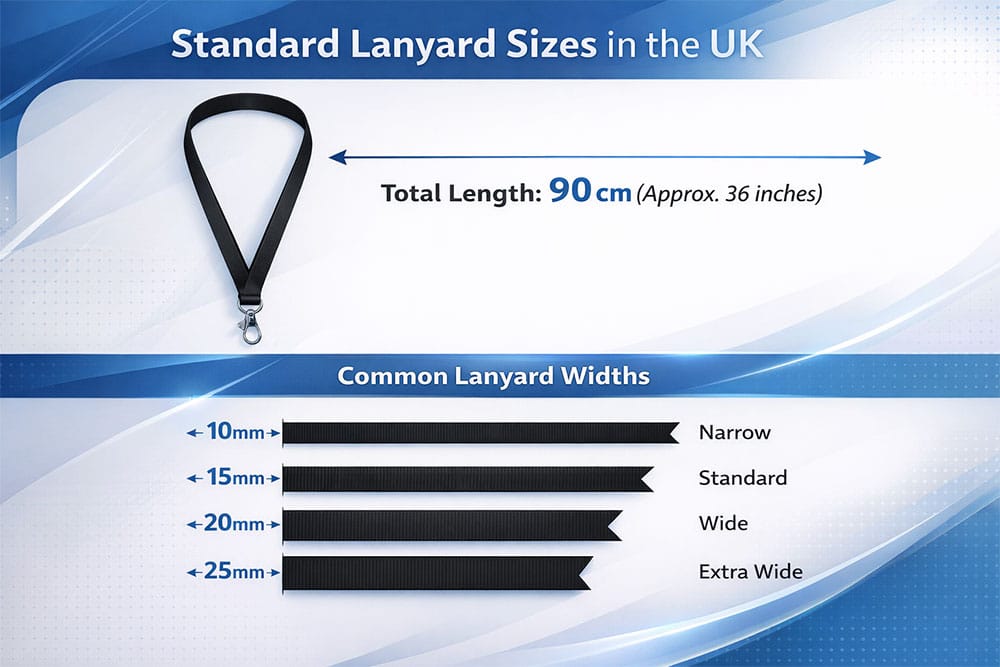
Typically in the UK lanyard sizes are 90cm in length and either 10mm, 15mm, 20mm or 25mm widths depending on the use.
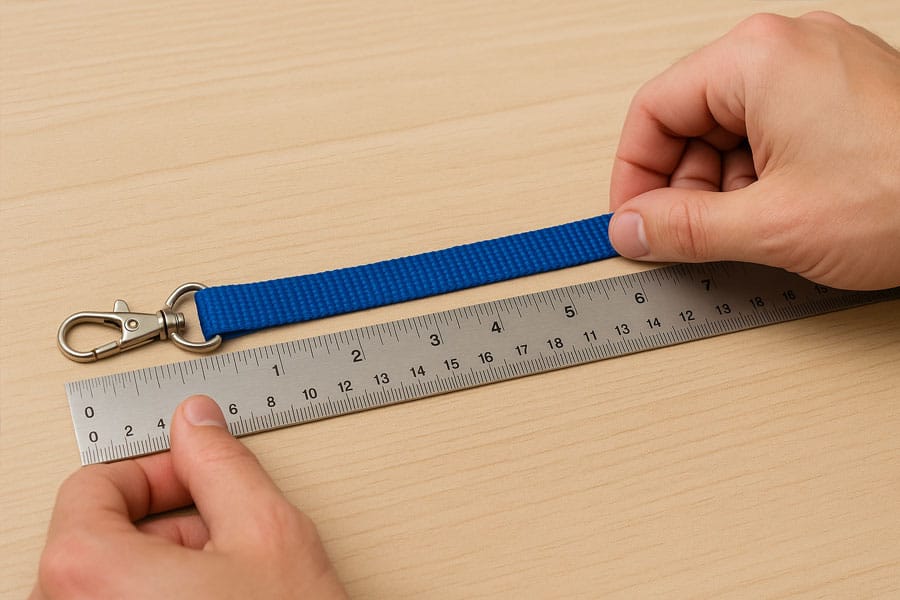
How to measure a lanyard you already have
If you’ve got an existing lanyard and you just want to match it:
- Lay the lanyard flat on a table and straighten it out.
- Measure from end to end with a tape measure or ruler – that’s the total lanyard length.
- Fold it in half and measure from the fold to the clip – that’s the drop length.
- Measure across the strap – that’s the lanyard width in mm.
Once you’ve got those measurements, you can use the lanyard size chart below to pick the closest standard size.
Standard lanyard lengths in the UK
Most adult neck lanyards in the UK are surprisingly consistent.
The default standard size
For a standard adult neck lanyard, you’re usually looking at:
- Total length: around 90 cm (900 mm)
- Drop length: around 45 cm (450 mm)
In other words:
- If you cut it and lay it flat, it’s about 90 cm
- When worn, the clip and card sit roughly in the upper to mid-chest area on most adults.
That’s the size you’ll get if you order “standard” or don’t specify anything else.
The most common lanyard size length in the UK is 90cm.
When to go shorter…
There are a few situations where a full-length lanyard is overkill:
- Children and smaller adults: A standard 90 cm lanyard can hang too low on smaller frames. For primary and secondary schools or youth groups, a shorter length (around 80–85 cm total) keeps badges higher and reduces the chance of them catching on things.
- Higher-risk environments: In workshops, warehouses and similar, it’s better for the badge to sit higher and closer to the chest. A slightly shorter length combined with breakaway connectors reduces the risk of snagging.
When to go longer…
On the flip side, you may want a touch more length if:
- You’re dealing with very tall wearers: For taller staff, a standard lanyard can sit unusually high. A 95–100 cm total length is sometimes used so badges still sit mid-chest instead of at the collarbone.
- You’re using very large passes: Oversize conference or festival passes can be tall. A slightly longer lanyard can stop them feeling like they’re right under someone’s chin.
You don’t need to obsess over this as the standard 90 cm works for the vast majority of people. Longer and shorter lengths are about fine-tuning comfort.
What about wrist lanyards?
Wrist lanyards are a different shape, but the same principle applies. You want them snug enough not to slip off, not so tight they cut in.
Typical wrist lanyards use:
- A loop that’s roughly 16–20 cm in internal circumference when closed.
Most suppliers create these by using a short strap folded into a loop and stitched or clipped.
Lanyard size chart (UK)
Use this lanyard size chart in cm, mm and inches as a starting point:
| User or use-case | Total length (cm) | Drop length (cm) | Total length (mm) | Approx. total length (inches) | Notes |
| Standard adult staff | 90 | 45 | 900 | ~36″ | Default choice for offices and workplaces |
| Tall adult (around 6’2″+) | 95–100 | 47–50 | 950–1000 | ~37–39″ | Helps badges sit mid-chest instead of very high |
| Children and youth groups | 80–85 | 40–42 | 800–850 | ~31.5–33.5″ | Better for smaller frames and reduced snagging |
| Workshops and higher-risk | 80–90 | 40–45 | 800–900 | ~31.5–35.5″ | Pair with breakaways for safety |
| Wrist lanyards | 16–20 | – | 160–200 | ~6.3–7.9″ | Keys, small passes, tickets |
If in doubt for general staff use, choose 90 cm. If you’re ordering for schools or kids, shorter is usually better.

A quick visual guide comparing standard, event, and children’s lanyard sizes — showing length, width, and key features at a glance.
Lanyard widths: how wide should the strap be?
Length decides where the badge sits. Width decides how the lanyard feels and how much branding you can fit on it.
The 4 main UK widths you’ll see are:
- 10 mm
- 15 mm
- 20 mm
- 25 mm
Some suppliers also offer extra-wide options (up to 30–40 mm), but 10–25 mm covers the vast majority of situations.
10 mm lanyards
Best for keys, USB sticks and subtle ID badges where you want something light and discreet. They’re cheap on material and visually minimal, but the narrow strap gives you very little print area, so logos and text will always be small.
15 mm lanyards
This is the everyday width for staff ID, schools and visitor passes. It balances comfort and visibility, giving you room for a readable logo without feeling big or bulky. Very detailed or text-heavy designs can still feel a little cramped compared with 20 mm.
20 mm lanyards
The go-to width for conferences, events, trade shows and branded giveaways. There’s enough space for strong, full-colour branding while still being comfortable for all-day wear.
25 mm (and wider) lanyards
Best when you want the lanyard itself to do the branding work – VIP passes, sponsor lanyards and high-visibility security. The extra width is great for legibility at a distance, but it does feel bulkier than standard office lanyards, so it’s usually overkill for simple day-to-day staff ID.
Width recommendations at a glance
| Width | Best for | Branding impact | Comfort level |
| 10 mm | Keys, subtle ID, backstage crew | Low | Very high |
| 15 mm | General staff ID, schools, visitors | Medium | High |
| 20 mm | Conferences, exhibitions, festivals | High | High |
| 25 mm and up | VIP, premium events, security, sponsors | Very high | Medium (bulkier on neck) |
If you want a safe ‘one size fits most’ for a branded lanyard:
- 15 mm for everyday staff ID.
- 20 mm for events and promotional use.
Matching lanyard size to your use
Here’s how to pull it together when you’re actually placing an order.
Lanyard size options
If you just want a quick recommendation, match your situation to the closest option:
| I need lanyards for… | Recommended length | Recommended width | Notes |
| Office staff ID | 90 cm total | 15–20 mm | All-day wear in offices and reception areas |
| Conference delegates | 90 cm total | 20 mm | Clear logo visibility in photos and networking |
| Festivals and VIP events | 90–100 cm total | 20–25 mm | Works over jackets and hoodies, strong branding |
| Primary and secondary pupils | 80–85 cm total | 10–15 mm | Lighter and shorter for smaller frames |
| Warehouse or workshop staff | 80–90 cm total | 15–20 mm | Slightly shorter plus breakaways for safety |
| Wrist lanyards for keys/passes | ~16–20 cm loop (wrist) | 10–15 mm | Handy for keys, access fobs and small tickets |
Office and workplace ID lanyards
For general office use, a 90 cm adult lanyard in 15–20 mm width is the safest choice. It sits comfortably mid-chest, is readable at a normal distance and doesn’t feel heavy or sharp on the neck. In busier or more physical environments such as warehouses and workshops, it’s worth going a touch shorter for some staff and specifying one or more breakaway connectors so the lanyard releases if it’s pulled or caught.

Typically, office and workplace lanyards are the same size with limited branding.
Conferences, trade shows and business events
For conferences and business events, stick with 90 cm length (95 cm if you know you’ve got a lot of very tall attendees) and 20 mm width as standard. If sponsors are buying logo space, move up to 25 mm so their branding actually gets seen in photos and videos. Always add a breakaway and a decent clip so badges don’t spin every time someone moves.
Festivals, concerts and VIP passes
Festivals, concerts and VIP setups usually benefit from 90–100 cm lanyards in 20–25 mm width. The slightly longer length works better over outerwear, and the wider strap carries bold artwork and event names far better. Combine that with a strong clip and at least one breakaway, especially if you’re dealing with younger audiences or crowded spaces.
Schools, colleges and youth groups
For schools and youth groups, keep student lanyards shorter and lighter: 80–85 cm in 10–15 mm width with a breakaway as standard. For staff, the normal adult 90 cm length in 15–20 mm width still works well, as long as you keep breakaways in the spec. Shorter lengths reduce swinging and make it less likely for badges to catch on furniture, lab equipment or playground structures.
Safety and comfort: when size becomes a problem
Even the right size lanyard can cause issues if you ignore basic safety.
Avoid overly long lanyards
If badges are consistently hanging:
- below the ribcage
- near belts or waistbands
- or catching on desks, chair arms or machines
…your lanyards are too long for your users. That’s a size issue, not just a design choice.
Always pair size with safety features
For neck lanyards, especially in schools, healthcare settings, warehouses, workshops and other public-facing roles, size and safety go hand in hand. Stick to sensible lengths for the environment and always specify at least one breakaway connector so the lanyard releases if it’s pulled or caught instead of becoming a snagging risk.
Common mistakes when choosing lanyard sizes
A few size-related mistakes come up again and again:
- Going too narrow for branding: choosing 10 mm lanyards for staff or events and then finding your logo is tiny and unreadable.
- Ordering one length for everyone: using full-length adult lanyards on small children or very petite staff so badges sit down by the waist.
- Ignoring the environment: using longer, heavier lanyards around machinery or moving equipment where shorter lengths and multiple breakaways would be safer.
- Choosing novelty extra-long lanyards: they might look fun on paper, but in practice they swing more, tangle more and catch on desks and chairs.
Fixing these usually just means being more deliberate about length and width choices up front. If people keep taking them off, wrapping them around their hand, or complaining, it’s usually a sign you’ve gone too long.
Commonly asked questions
About the author