Table of contents
- Why the right lanyard attachments matter
- The main types of lanyard attachments, clips and hooks
- Safety breakaways and other safety fittings
- Passes, ID holders and badge wallet attachments
- Custom designed lanyard attachments and branded hardware
- Specialist lanyard attachments
- Choosing lanyard attachments by environment
- Commonly asked questions
When people think about lanyards, they usually picture the strap: the colour, the branding, the width. But from a practical point of view, lanyard attachments do most of the real work.
The attachment is the part that actually holds something, such as an ID card, a badge wallet, a set of keys, a radio, a phone. Get that wrong and it doesn’t matter how nice the strap looks; the lanyard will twist, snag, break, or just annoy the person wearing it.
This comprehensive guide will walk you through the main types of lanyard attachments, what they’re best for, and how to choose the right combination for your staff, visitors or event.
Why the right lanyard attachments matter
The attachment might look like a tiny detail, but it affects:
- What you can safely carry: PVC badge, key bundle, a heavy tool or device.
- How comfortable the lanyard is to wear: especially for all-day use.
- How long it lasts: poor fittings are usually the first thing to fail.
- How secure your ID system is: cards falling off the end is not a good look.
- How tidy everything looks: no tangles, no ugly improvised clips.
So when you’re specifying personalised lanyards, spend a bit of time pairing the right attachments for your brand or the environment it will be used in.
The main types of lanyard attachments, clips and hooks
Most lanyard attachments fall into a handful of familiar shapes. The names vary from supplier to supplier, but the functions are consistent.
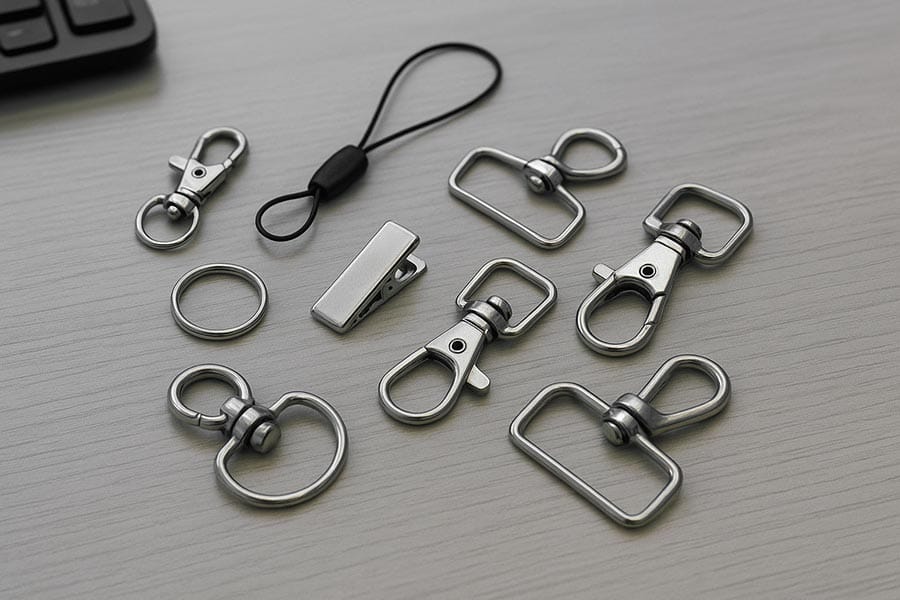
Trigger clips, lobster clips or swivel hooks and the most popular type of lanyard attachments.
Trigger clips, lobster clips and swivel hooks
This is the classic metal clip you’ll see on most staff lanyards: a small, spring‑loaded metal hook that opens when you press a lever and usually sits on a swivelling base. That swivel allows the badge or ID holder to move freely without twisting the strap, while the metal construction is strong enough for everyday ID cards, a couple of keys or a light device and still easy to operate one‑handed.
Typically used for:
- General office ID cards.
- Schools, colleges and universities.
- Staff who also carry one or two keys or a small fob.
If you’re not sure what you need, a metal swivel trigger clip is usually the safest default.

Dog clips or J-clips
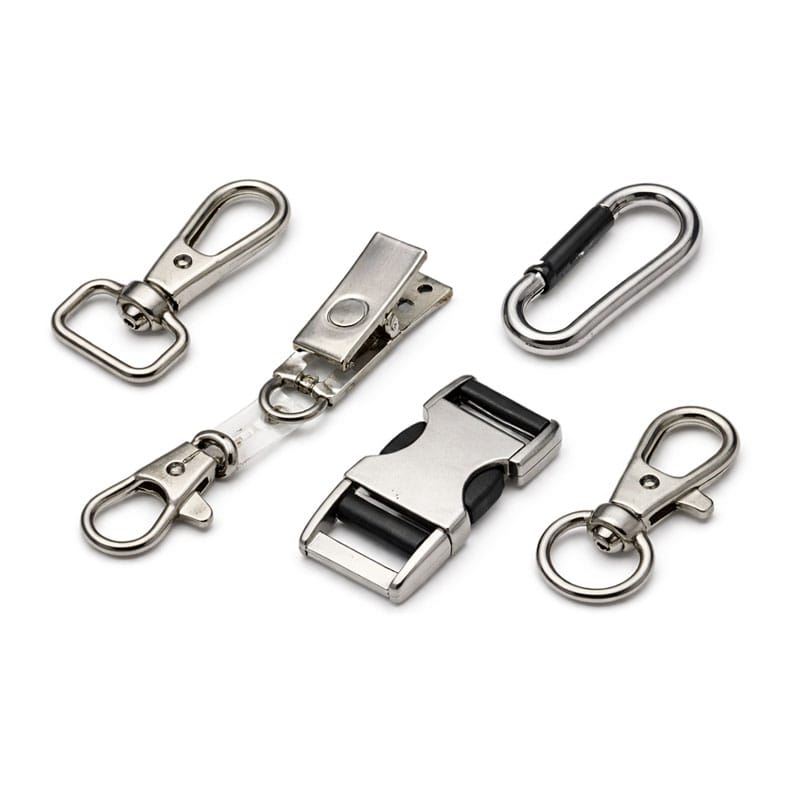
Dog clips (sometimes called J‑clips) are flat, springy metal clips that open when you pinch the sides and clamp shut directly onto a punched card or plastic holder. With no moving hook and a very low profile, they work particularly well with rigid card holders that have a central slot.
Typically used for:
- Environments where you want a very flat, tidy
- Cards that already have a clip hole or keyhole slot.
- Situations where the card doesn’t need to rotate much.
They’re simple and robust, but slightly less flexible if you plan to swap between different holders or accessories.
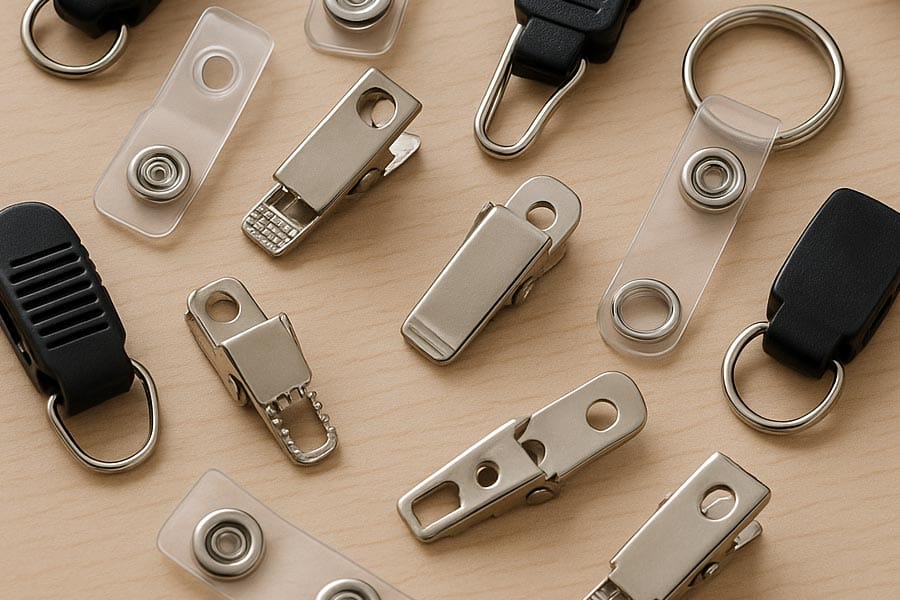
Lanyard badge clips and grippers are a popular method of attaching ID holders and plastic wallets.
Lanyard badge clips and grippers
Badge clips are small metal or plastic fittings with a short strap and a button or snap fastening. Badge grippers are plastic jaws that pinch the edge of a card without needing a punched hole. Both options let the card or badge hang directly from the lanyard without a full ID holder. This can be useful where contactless or RFID cards cannot be punched.
Typically used for:
- Temporary staff and visitors.
- Environments where you don’t want visual bulk.
- Quick, low-cost ID solutions.
They’re simple and flexible but offer less physical protection than full card holders or wallets.
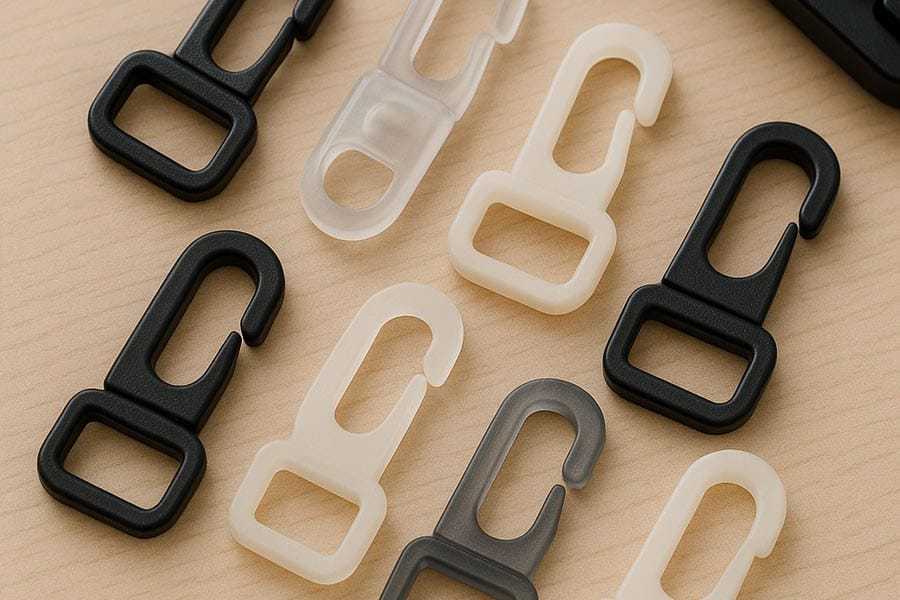
Plastic hooks and clips are some of the cheapest ways to attach lanyard ID cards.
Plastic hooks and budget clips
Plastic hooks and clips are lightweight, cost effective fittings that snap or clip onto holders and cards. They’re much cheaper than metal options, and because the plastic will often fail before the strap, they can also act as a basic safety feature by breaking under heavy load.
Typically used for:
- One-off promotions and giveaways where cost is a priority.
- Low-risk environments.
- Children’s events and youth groups.
For everyday staff ID in professional settings, metal clips usually feel more solid and look better. Plastic hooks are fine when you need something light, cheap and low-risk.
Safety breakaways and other safety fittings
For many buyers, safety fittings are just as important as the main attachment.

Safety breakaway clips for lanyards help keep the wearer safe and reduce a host of risks.
Safety breakaway clips
A safety breakaway is a small plastic connector built into the lanyard strap that snaps open under strain. If the lanyard is pulled sharply or gets caught, the breakaway releases before anything more serious happens.
Why they matter:
- Reduce the risk of strangulation or injury if a lanyard gets snagged.
- Particularly important in schools, healthcare, warehousing and industrial
- Required by many organisations’ health and safety policies.
Some lanyards have a single breakaway attachment at the back of the neck, while others have multiple breakaway points further down the strap. The more physical the work, the more sense extra breakaways make.
Multiple attachments and detachable buckles
You’ll often see lanyards with a detachable buckle (sometimes called a “release clip”) part way down the strap.
This lets the wearer:
- Unclip the bottom section with the ID or keys.
- Use or present the card easily (for example, at a reader).
- Clip it back on without taking the lanyard off.
These buckles are useful when:
- Staff need to tap cards on wall-mounted readers.
- Keys or tools need to be used away from the body.
- Devices are handed to customers (e.g. tablets in retail or hospitality).
You can combine detachable buckles with safety breakaways for maximum flexibility and safety for your branded lanyards.

Primary lanyard attachments include passes, ID holders and badge wallets.
Passes, ID holders and badge wallet attachments
Clips and hooks are only half the story with lanyard attachments. In everyday use, most lanyards end up holding passes, ID cards and badge wallets. The way you carry and present that pass is just as important as the hardware at the end of the strap.
Broadly, you’re choosing between:
- Rigid plastic ID card holders: for long‑term, everyday staff ID.
- Enclosed or heavy‑duty holders: for tougher environments.
- Soft PVC wallets and badge pouches: for paper inserts and event passes.
- Laminated passes and oversize badges: for conferences, festivals and VIP.
- Printed plastic cards: when the card itself is the permanent ID.
Each option has its own sweet spot for durability, appearance, flexibility and value for money.

Plastic ID holders are a popular attachment as they are durable and re-usable.
Rigid plastic ID card holders (open‑faced)
Rigid open‑faced holders are the workhorse of ID systems. A single plastic frame supports the card from behind while leaving the front fully visible.
They score well on:
- Durability: they protect cards from bending and snapping.
- Readability: photos, names and barcodes are easy to see and scan.
- Value: once you own the holder, you usually only replace the card.
Best for:
- Everyday staff ID in offices, schools and colleges.
- Roles where cards are scanned repeatedly at doors or turnstiles.
- Organisations that want a neat, consistent look across departments.
Open‑faced holders are usually the most cost‑effective long‑term option when people wear the same card every day.
Enclosed and heavy‑duty card holders
Enclosed rigid holders surround the card with plastic and expose it through a clear window. They offer more physical protection and make it harder to slip a different card in unnoticed.
They’re ideal when:
- Cards control secure access or expensive equipment.
- The environment is rough like warehouses, workshops, outdoor.
- Cards need protection from moisture, dirt or frequent knocks.
The trade‑off is convenience: enclosed holders take a little longer to open, so they’re best when cards stay with the same person for months or years. They cost slightly more per unit than basic open‑faced frames but often save money by reducing the number of damaged cards you have to reissue.

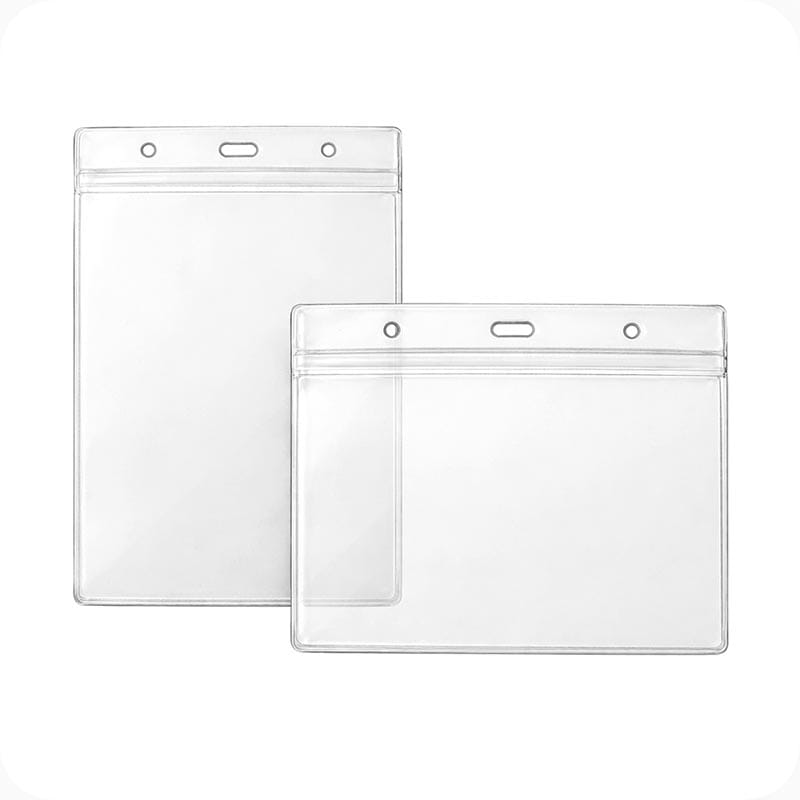
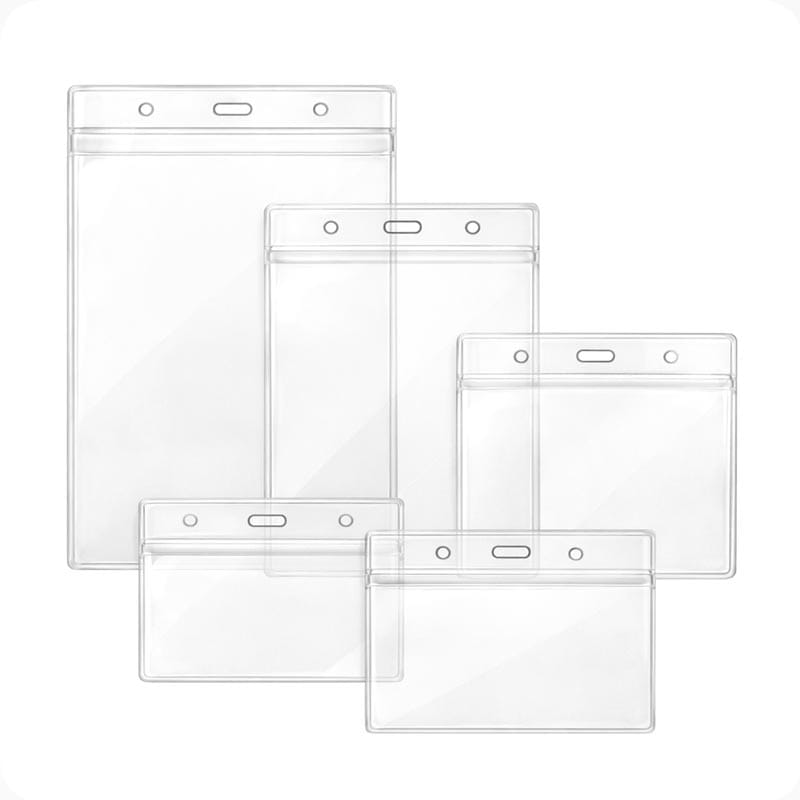
Soft PVC wallets come in a range of sizes but are typically A6 portrait or landscape.
Soft PVC wallets and badge pouches
Soft PVC wallets are flexible, transparent sleeves that hang from a lanyard via a slot or punched holes. They’re designed to hold paper inserts rather than rigid plastic cards.
They shine when:
- Information changes frequently like dates or room numbers.
- You’re issuing temporary passes for visitors, open days or training.
- You need to display extra detail like schedules, maps or barcodes.
Typically used for:
- Conferences, exhibitions and trade shows.
- Visitors and short‑term contractors.
- Open days, parents’ evenings and campus events.
PVC wallets are cheap, flexible lanyard attachments and easy to re‑use, but they’re not as tough as rigid holders. For everyday staff ID they tend to get cloudy or creased over time, so they’re better treated as temporary passes rather than a permanent solution.
You can also get zip‑top or waterproof PVC wallets for outdoor events and wet environments, which offer extra protection for paper inserts.

Laminated event passes can deliver a premium feel and will last multiple days.
Laminated event passes
Laminated passes sit somewhere between paper inserts and plastic cards. Artwork is printed on card stock and then laminated, usually with a hole or slot punched for a clip.
They work well when:
- You want a premium‑looking pass without committing to full plastic card production.
- Passes only need to last for a few days but must look good and survive constant handling.
- You’re producing VIP, crew or backstage passes for events and festivals.
Laminated passes have a higher unit cost than plain paper inserts in PVC wallets, but they feel more substantial and photograph better for social media and press shots.
Oversized and VIP passes
For some events, the pass itself is part of the experience. Oversized or VIP passes are larger than standard ID cards and often use bold artwork, foiling or spot colours.
They’re designed to:
- Be instantly recognisable at a distance.
- Signal status like VIP, crew, artist, sponsor.
- Perform well in photos and video.
These passes are usually worn in wider PVC wallets or special holders and often work best with double‑clip lanyards so they don’t spin around. They cost more to produce, but that’s part of the point – they’re meant to feel a level up from a normal badge.
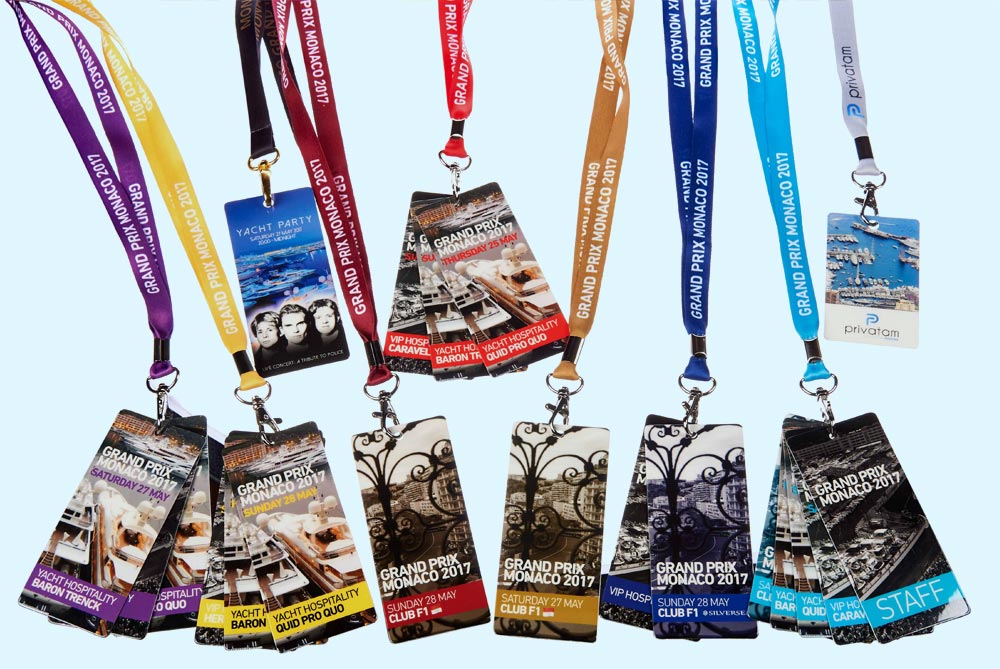
Custom branded lanyards and attachments are perfect for company promotions
Custom designed lanyard attachments and branded hardware
Off‑the‑shelf clips and hooks will cover most everyday needs, but some organisations want their lanyards to do more than carry a card. At that point, the focus shifts from standard fittings to custom designed lanyard attachments and branded hardware.
These might be soft PVC pieces shaped like a logo or product outline, bespoke metal fittings with subtle engraving, or carefully engineered clips and tags created for a specific role. In each case, the attachment becomes part of the brand experience rather than just a way of holding an ID badge.
Custom attachments tend to appeal to brands running high‑profile campaigns or premium events, agencies managing flagship activations, and organisations who know their staff will wear lanyards in front of important clients, VIPs or broadcast cameras. They’re also useful where the attachment itself has a job to do – for example, a specialist tool clip for engineers, or a distinctive key fitting for facilities teams working across large estates.
Specialist lanyard attachments
As lanyards have become more common, so have specialist fittings. These are worth knowing about even if you don’t need them immediately.
Phone and device loops
These are small loops or silicone holders designed to attach mobile phones or small devices to a lanyard.
Useful for:
- Staff who use work phones, handheld scanners or small tablets constantly.
- Environments where dropping a device would be expensive or dangerous.
- Temporary uses at events – for example, scanning teams at registration.
If you go down this route, make sure the lanyard itself is comfortable and strong enough for the extra weight.
Retractable badge reels (yo-yos)
Badge reels are retractable reels that connect between the lanyard and the card. You pull the card out to a reader and the reel automatically winds it back in.
Benefits:
- Staff don’t have to remove the lanyard or lean awkwardly to reach readers.
- Cards are less likely to be dropped on the floor.
- Particularly handy for turnstiles and repeated door access.
Retractable reels can clip to lanyards, belts or pockets. On lanyards, they work best in controlled environments (offices, labs, IT suites) where there’s minimal risk of snagging on equipment.
Whistles, pens, tools and promo gadgets
Lanyards can also carry:
- Whistles: for sports coaches, lifeguards, event marshals.
- Pens and styluses: useful in healthcare and warehouse settings.
- Small tools: cutters, torches or remote controls in specific roles.
- Pure promotional items: branded charms, mini-torches, bottle openers.
In these cases the attachment choice is about weight and movement: heavy or moving items usually need stronger metal clips, possibly backed up with split rings.
Choosing lanyard attachments by environment
To make this practical, here’s how you might think about lanyard attachments in different settings.
Offices and corporate environments
Priorities: professional appearance, clear ID, day-long comfort.
Typical setup:
- Branded strap with safety breakaway.
- Metal swivel trigger clip.
- Portrait rigid card holder or simple badge clip.
If staff also carry a door fob, you might add a split ring or choose holders designed for proximity cards.
Education (schools, colleges, universities)
Priorities: safeguarding, clear roles, safety around children.
Typical setup:
- Colour-coded lanyards for staff, visitors, contractors and students.
- Safety breakaway as standard (often more than one).
- Metal clip or plastic hook depending on risk assessment.
- Rigid holders for staff, PVC wallets for visitors and temporary passes.
Teachers and senior staff might also carry keys on their lanyards, so split rings creep in here too.
Healthcare and clinical environments
Priorities: hygiene, identification, safety, minimal snagging.
Typical setup:
- Smooth, wipeable strap with breakaway.
- Metal trigger clip or neat badge clip.
- Flush, enclosed card holders that are easy to wipe down.
Some trusts and clinics avoid bulky attachments altogether and prefer lightweight badge clips; others accept slightly heavier fittings for specific roles (e.g. duress alarms, radios).
Warehousing, industrial and facilities
- Priorities: safety around machinery, durability, key/tool management.
Typical setup:
- Strong strap with multiple safety breakaways.
- Split rings for keys and small tools.
- Trigger clips or carabiner-style hooks for heavier items.
- Armband holders or belt-clip reels where neck lanyards aren’t appropriate.
Here, attachments are doing more heavy lifting; it’s worth specifying higher-grade metal fittings and regularly checking for wear.
Events, conferences and exhibitions
Priorities: clear ID at a distance, fast issuance, sponsor visibility.
Typical setup:
- Branded strap with one or two safety breakaways.
- Either:
- Double metal clips to keep a wide event pass facing forward, or
- A single clip into a PVC wallet for paper inserts.
- Occasionally, phone loops or badge reels for scanning staff.
Attachments need to play nicely with badge design and photography – double clips and wider holders are popular because they stop passes spinning in photos.
Commonly asked questions
About the author